
Norfolk County Court Records After a Jail Arrest
After a Norfolk County arrest, the first record is usually a booking or custody entry. That record may identify the arresting agency, a stated charge, bail information, warrants, or a hold. The court record starts when the criminal charge is brought into the Massachusetts Trial Court system. In Norfolk County, the Norfolk District Attorney's Office proceeds on criminal cases for the county's cities and towns, and the court file then tracks the charge from arraignment through later events.
A jail record and a court record answer different questions. The jail side confirms custody, release eligibility, bail processing, warrants, and detainers. For custody status, use jail inmate records; for booking-photo access, use jail mugshots. Court records after an arrest show the filed charges, amendments, dismissals, dispositions, and future court dates. If a booking charge and a court charge do not match, the court docket is the better source for what the prosecutor filed and what the judge acted on.
Arrest, Booking, Bail, and the First Court Event
The common Norfolk arrest-to-court path is sequential. A person is arrested, brought through booking, screened for bail or a hold, and then brought to arraignment or another first court event. The arraignment is usually where the public court record becomes easier to follow because the case receives a docket entry, charges are read, bail or release conditions may be reviewed, and the next date is set.
The Norfolk District Attorney's Office is led by Michael W. Morrissey and handles criminal offenses from 27 Norfolk County towns. The office reports roughly 130 employees and about 20,000 cases per year. Police reports and booking entries can begin the process, but the prosecutor's charging decision controls what appears in the court case.
How to Find Norfolk County Court Records After an Arrest
Massachusetts court case access starts with the Trial Court's docket and calendar resources at Mass.gov court dockets, calendars, and case information. The public portal at MassCourts can be used for case lookup, but the portal warns that it is not the official court record. For certified copies, complete docket review, or case-file questions, contact the clerk for the court where the case is pending.
- Open the Mass.gov court docket and case information page or the MassCourts portal.
- Select the court department and court division when those fields are available.
- Search by defendant name, case number, case type, or date and calendar information.
- Open the matching case and review the charge list, event history, next date, and disposition entries.
- Confirm unclear entries with the clerk because online docket text can lag behind the official file.
The Norfolk County Superior Court is at 650 High Street, Dedham, MA 02026. The clerk's office phone is (781) 326-1600, and email is Norfolk.clerksoffice@jud.state.ma.us. Public hours are Monday through Friday, 8:30 a.m. to 4:30 p.m.
| Search Field | How It Helps | Practical Note |
|---|---|---|
| Court Department | Separates Superior, District, Boston Municipal, Housing, Probate, and other departments. | Criminal cases from an arrest are usually in a criminal court department, not the jail system. |
| Court Division | Narrows results to the courthouse or division handling the case. | Use the division named on paperwork from arraignment or the clerk. |
| Case Type | Limits results to criminal, civil, or other categories. | Choose criminal when tracing charges after a jail arrest. |
| Name | Finds cases by party name. | Try spelling variations and confirm by date of birth only through official channels when allowed. |
| Case Number | Finds a specific docket quickly. | This is the cleanest search when the number appears on bail, summons, or court paperwork. |
| Date or Calendar | Finds scheduled events and daily calendars. | Useful when an arraignment or next event is known but the docket number is not. |
MassCourts is the public access point most people recognize for online docket searching. This image links to the public portal that identifies itself as public case access rather than the official court record.
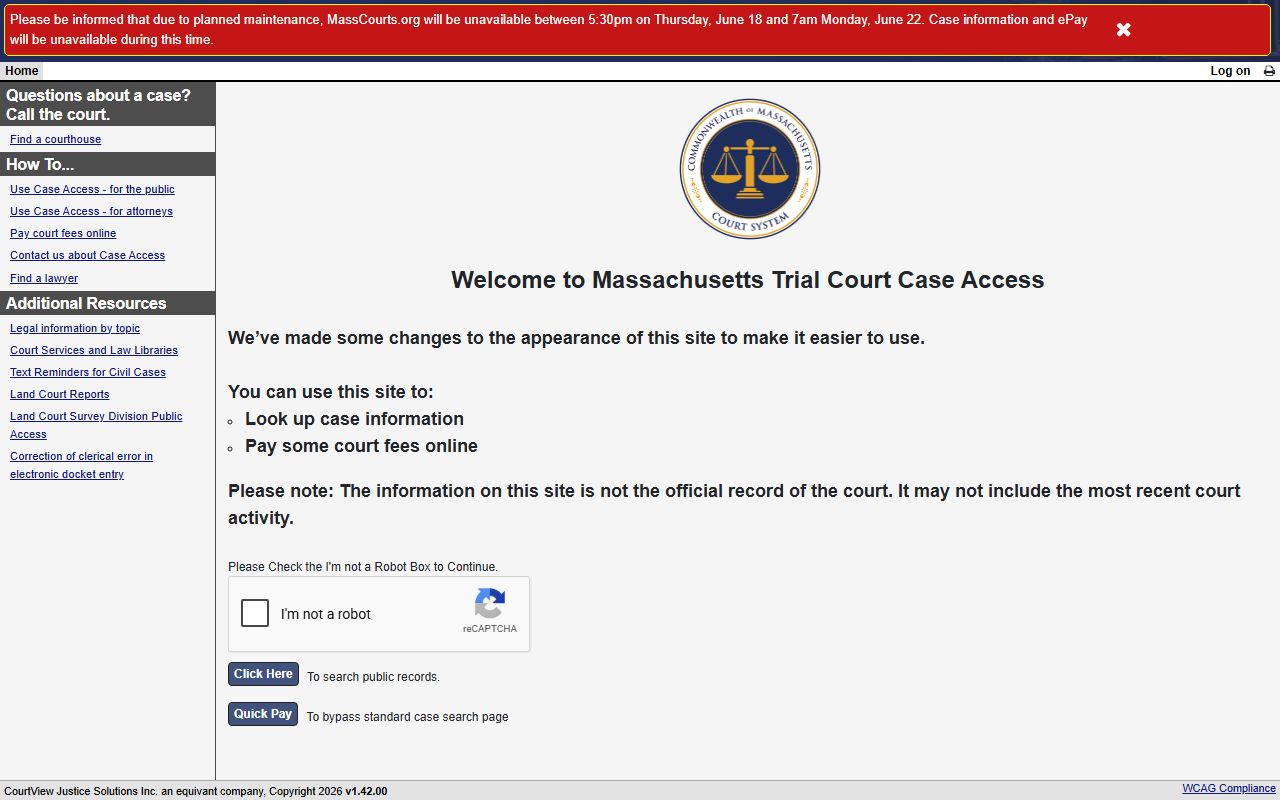
Use the online result as a pointer to the case, then rely on the clerk or official docket for certified or disputed details.
How Charges Get Filed After an Arrest
The charging document is the bridge between an arrest and the court record. A booking entry may reflect the offense named by police at intake, but the complaint, indictment, or related filing is what places a criminal accusation before the court. Once the case is docketed, later entries can show amendments, added counts, dismissed counts, continuances, bail changes, pleas, trial events, or sentencing.
| Document | What It Does | What to Check |
|---|---|---|
| Application or Complaint | Begins many criminal cases and identifies the offense charged in court. | Look for the count, statute, date, and whether the charge remains pending. |
| Indictment | Moves a serious felony into Superior Court after grand jury action. | Compare the indictment counts with earlier District Court or booking language. |
| Amended Complaint | Changes the charge language, level, or count after filing. | Do not assume the original booking charge is still the active charge. |
| Disposition or Judgment Entry | Records the result for a count after dismissal, plea, trial, or sentencing. | Read each count separately because one case can have different outcomes. |
Charge Status in Court Records After an Arrest
Charge status tells whether the accusation is still active. A case may start with several counts, then some counts may be reduced, dismissed, continued without a finding, resolved by plea, or set for later hearing. The docket should be read count by count, not just by the case heading.
| Status | What It Means | Why It Matters |
|---|---|---|
| Pending | The charge remains open and has not reached final disposition. | Future dates, bail terms, and release conditions may still apply. |
| Amended or Reduced | The filed charge changed after arraignment or negotiation. | Background checks and court summaries should use the current court charge, not only the arrest label. |
| Dismissed | The court ended that count without a conviction on that count. | Other counts in the same case may still have separate outcomes. |
| Nolle Prosequi | The prosecutor entered a decision not to proceed on the charge. | It is a prosecutor action and should not be described as a conviction. |
| Guilty or Responsible | The charge resulted in a plea, finding, or judgment against the defendant. | Check the sentence, probation terms, fines, and any later modification. |
Bail, Holds, and Release Records After a Norfolk Arrest
Massachusetts bail decisions are governed in part by M.G.L. c.276 s.58. For a person held at the Norfolk County Correctional Center, jail bail hours are weekdays from 4:30 p.m. to 9:30 p.m. and weekends or holidays from 12 p.m. to 9:30 p.m. Call (781) 329-3705 before going to the facility to confirm that the person is bailable, the bail amount, the bail commissioner fee, and whether any warrants or detainers block release.
A person posting bail should be at least 18 and have valid photo identification. The jail advises that the process may take about two hours. Bail information can appear differently across records: the jail can confirm immediate custody and release processing, while the court docket shows the judicial bail order, later bail review, and release conditions.
| Release Issue | Where It Usually Appears | What to Confirm |
|---|---|---|
| Bail amount | Jail custody record and court docket | Confirm the current amount before travel because court orders can change. |
| Bail commissioner fee | Jail bail process | Ask the jail what payment form is accepted. |
| Detainer or hold | Jail record or agency notice | A separate hold can prevent release even when bail is posted. |
| No bail or dangerousness issue | Court docket | Review the court event that ordered continued detention. |
Warrants That Lead to an Arrest
No official Norfolk sheriff active warrant search was located for public use. A warrant may still explain why a person was arrested, why the jail accepted custody, or why release is delayed after bail is otherwise available. Practical checks include calling the jail information line, checking MassCourts for an open criminal docket, contacting the relevant clerk's office, reviewing local police public-record policies, or filing a public records request with the agency that created the record.
Warrants can also complicate court records after an arrest because one custody event may involve a new charge plus an older default warrant. In that situation, the jail can describe the hold or custody reason, but the court dockets must be checked separately for each case number.
Charges vs Convictions
An arrest and a charge are accusations, not proof that the person committed the offense. A conviction requires a guilty plea, finding, verdict, or other qualifying judgment. Read each count separately because only some counts may reach a final outcome.
| Question | Charge | Conviction |
|---|---|---|
| Stage | Filed accusation after arrest or summons. | Final result after plea, verdict, or finding. |
| Proof | Based on probable cause or charging decision. | Requires proof beyond a reasonable doubt or a valid plea. |
| Record Meaning | Shows what the prosecutor alleged. | Shows the case outcome for that count. |
| Use in Summaries | Describe as pending, dismissed, amended, or filed. | Describe only when the docket shows a conviction or equivalent final finding. |
Sealed vs Expunged Court and Arrest Records
Massachusetts access can be limited by sealing, juvenile confidentiality, CORI rules, investigatory exemptions, and case-specific orders. M.G.L. c.276 s.100A addresses sealing eligibility for certain criminal records. Juvenile access is also limited, including under M.G.L. c.119 s.60A. When a record is sealed, the public may not see information that once appeared in a court or arrest record, even though some agencies may retain limited access for authorized purposes.
| Record Treatment | What It Means | Effect on Public Lookup |
|---|---|---|
| Sealed | The record is hidden from ordinary public access by statute or court action. | Online search results may disappear or show limited information. |
| Expunged | The record is treated more completely as removed when legal standards are met. | Public lookup should not be expected to show the case in the same way. |
| Juvenile Restricted | Juvenile case access is limited by separate Massachusetts rules. | Do not assume a missing juvenile record means no arrest occurred. |
| Investigatory or CORI Limited | Access may be withheld to protect an investigation, privacy, or regulated criminal offender record information. | Requesters may receive denials, redactions, or instructions to use another process. |
Norfolk County Superior Court is an official point for serious criminal case files and clerk questions. This image links to the Mass.gov location page for the court.
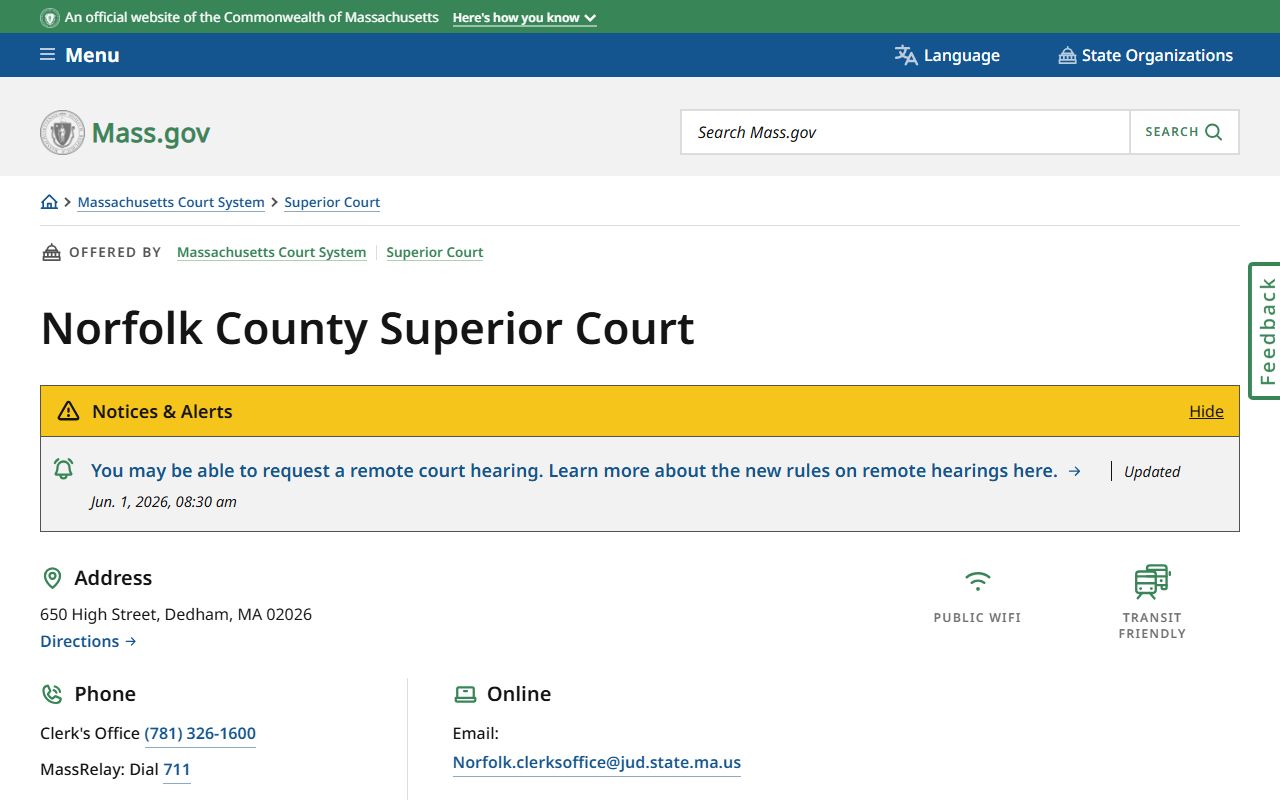
Online search is useful for orientation, but courthouse records control when a docket entry is unclear or incomplete.
Public Records Limits for Court Records After an Arrest
Massachusetts public-record access begins with the definition in M.G.L. c.4 s.7 cl.26 and the request procedure in M.G.L. c.66 s.10. Those laws do not mean every jail, police, prosecutor, or court document is fully public the moment someone is arrested. Records may be withheld for privacy, juvenile status, witness and victim safety, CORI restrictions, sealed cases, and investigatory reasons.
The sheriff's statutory custody role is also separate from the court's docket role. M.G.L. c.126 s.16 addresses sheriff custody and control, while M.G.L. c.126 s.40 concerns jail population reporting. Those duties help explain why jail population and custody information can exist without providing a complete public court case file.
Important: Norfolk County Inmate Population is not a consumer reporting agency, and these records may not be used for FCRA-covered decisions.